Powder Tanker Truck Design Guide: Horizontal vs Vertical vs Tipping for Bulk Cement Buyers
Buying a Chinese powder tanker or cement bulker? Tank shape drives residual rate, discharge speed and site needs. This buyer guide compares horizontal, vertical and tipping designs, explains fluidization in plain English, and lists what to check before you order a tractor + bulker setup.
Last updated: November 5, 2026
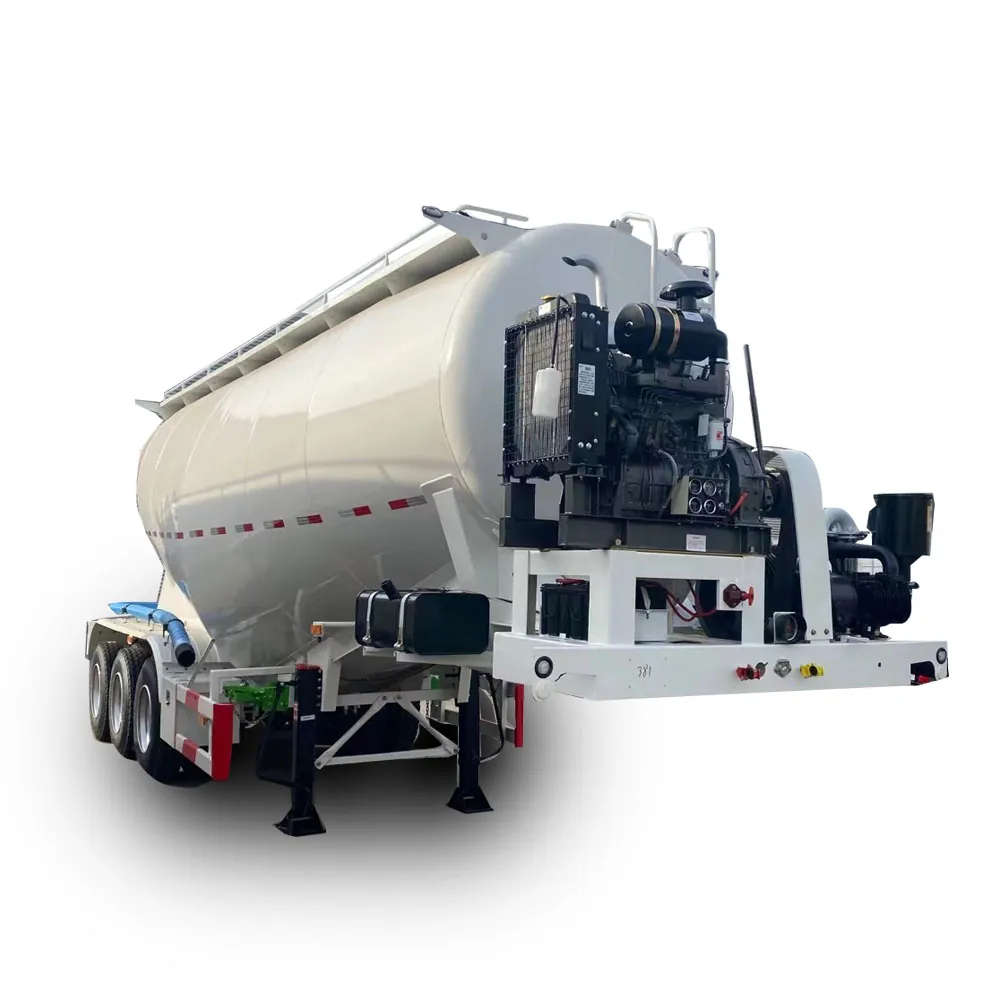
If you already run bagged cement, a powder tanker cuts packing labour and dust at the plant — but only if the tank shape, fluid bed and compressor match the powder you haul. This guide turns a Chinese tank-vehicle design topic into a practical overseas buyer checklist. Browse cement bulker trailers, the 3-axle bulker cement 50-ton trailer, matching tractor trucks, or send an inquiry.
What a powder tanker actually is
A powder tanker (粉罐汽车 / bulk powder tank vehicle) is a tank truck or semi-trailer built to carry dry powder and granular materials in bulk: cement, fly ash, flour, lime, plastic pellets, meal, and similar cargos. Overseas buyers usually meet it as a cement bulker trailer pulled by a tractor.
Two unload families exist:
- Gravity — powder slides out under its own weight (simple sites; limited cargos).
- Pneumatic — compressed air fluidizes the bed so powder flows through a pipe into a silo. This is the mainstream export configuration today.
Semi-trailer layouts are growing for legal payload and volume. Rigid trucks (4×2 / 6×2 / 6×4 / 8×4) still appear on shorter routes. Full trailers are often road-restricted in China and mainly yard use there — treat that as China context, not your destination rulebook.
Why powder behaviour decides the tank you should buy
You do not need the textbook formulas. You do need three buyer ideas:
| Idea | Why it matters on the quote |
|---|---|
| Bulk / particle density | Sets payload for a given volume (e.g. cement true-density tables in design texts often show about 3200 kg/m³ with fine particle size). |
| Angle of repose + wall friction | If the tank floor is flatter than the powder can slide, you need a fluid bed (or tip the tank). |
| Fluidization | Above a critical air speed, the bed behaves liquid-like: it levels when tilted and can leave through a side outlet — the basis of pneumatic unload. |
Design tables for critical fluidization velocity (vf) often put cement near about 0.009–0.015 m/s and flour higher (about 0.03–0.05 m/s). Sticky or moist powder behaves worse; free moisture is a common discharge killer. Tell the factory your exact cargo, moisture and silo height — not only “cement tanker.”
Performance numbers buyers should put in the PO
Chinese tank-vehicle design practice commonly discusses:
- Average discharge rate — mass (kg/min) or volume; residual rate i = leftover ÷ rated payload × 100%.
- Typical targets stated in that literature: average discharge ≥ about 1 m³/min; bulk cement ≥ about 1200 kg/min. Treat these as industry design practice from the source topic, not as a blanket HOWO guarantee for every SKU.
- Working pressure: many powders convey stably near ~0.15 MPa; China typical rated working pressure is about 0.2 MPa. Going above 0.2 MPa is mainly for high bulk density, long distance or dense phase.
- Airflow must fluidize the bed, keep pipe velocity safe, and still meet the discharge rate you bought.
Example product numbers (site PDP only)
On the live 3 Axle Bulker Cement Trailer 50 Ton page (fetched Nov 5, 2026):
| Spec | Listed value |
|---|---|
| Capacity | 42 m³ |
| Payload | 50,000 kg (50 tons) |
| Tank wall / heads | 5 mm / 6 mm (Q345B) |
| Tank shape | V-shaped with W-type fluidized bed |
| Working pressure | 0.2 MPa |
| Design pressure | 0.3 MPa |
| Safety valve relief | 0.25 MPa |
| Compressor | Diesel-driven 12 m³/min |
| Discharge speed | 1.2–1.5 tons/minute (about 35–40 min full load) |
| Manway | 500 mm with dust collector |
| Residual rate | < 0.3% |
| Axles | 3 × 13-ton BPW or FUWA |
| Discharge outlet | 4-inch butterfly valve |
Do not collapse 0.2 / 0.25 / 0.3 MPa into one number when you compare suppliers.
Horizontal vs vertical vs tipping (decision table)
| Aspect | Horizontal | Vertical | Tipping (lift) |
|---|---|---|---|
| Cost | Medium | Higher | Highest (lift gear) |
| Fluid bed | Large, full length | Small, cone bottom | Small, rear cone |
| Residual rate | Highest of the three | Low | Low |
| Discharge speed | Medium | Slower (bay by bay) | Fastest |
| Stability on road | Good (low CG) | Worse (high CG) | Good when travelling flat |
| Materials | Best for powders that fluidize well | Wide range | Wide range |
| Maintenance | Less | More | Most |
| Site needs | Low | Low | Needs firm, flat ground |
| Segregation risk | Mixed cargos may layer | Little | Little |
How to read the table
- Horizontal: longitudinal slide angle is often below the repose angle, so you need a full-length fluid bed and side slides. Common export cement bulker pattern when residual can be managed.
- Vertical: steep cones (often near ~45°) above repose → small fluid bed at the outlet; inverted cones are the visual hallmark.
- Tipping: front lifts up to about ~45° so the tank acts like one vertical silo; fluid bed mainly at the rear cone. Fast clean-out, more mechanism, and a ground that will not sink under the lifted unit.
For most overseas bulk cement distributor and ready-mix routes, a horizontal / V-body semi-trailer with a proper fluid bed (as on our 3-axle bulker) is the usual starting point. Switch to vertical or tipping only when residual, multi-powder flexibility or discharge time clearly justify the cost.
Assemblies to check on the factory quotation (buyer checklist)
Skip the long strength formulas. Ask for these in writing:
- [ ] Working vs design vs relief pressure named separately; hydrostatic / airtightness test method stated
- [ ] Manhole / fill diameter (practice often >450 mm; our PDP lists 500 mm with dust collector)
- [ ] Compressor type and drive (diesel / electric / PTO), free-air delivery at the stated working pressure
- [ ] Fluid bed type (cloth / bag / hopper / nozzle); cloth heat rating if you haul hot ash
- [ ] Piping: check valve, safety valve, secondary (boost) air; discharge pipe size (often 100 mm / 4"); bend radius ideally ≥ about 7× diameter
- [ ] Outlet style (top-suction / bottom / side) — residual vs clog trade-off
- [ ] Tractor match: fifth wheel, ABS/EBS connectors, axle rating for your roads
China design notes sometimes say tanks ≤0.2 MPa may follow a lighter design path than full GB 150, while >0.2 MPa (and some ash dump trucks) follow GB 150. That is China design practice, not destination law — confirm what certificate your import channel needs.
Lightweight trends you may see on quotes: thinner walls at carefully controlled working pressure; aluminium tanks (tare down, corrosion oxide film); demountable powder tank containers for multi-use chassis. Treat optional aluminium claims as configuration choices, not defaults.
FAQ
What is a powder tanker truck used for?
A powder tanker (also called a cement bulker or bulk powder trailer) moves dry powder and granular cargos in bulk — typically cement, fly ash, lime, flour and similar materials — without bags. Most modern units unload with compressed air after the powder is fluidized inside the tank.
Horizontal vs vertical vs tipping: which powder tank should I buy?
Horizontal tanks cost less and travel with a low centre of gravity, but they need a full-length fluid bed and usually leave more residual. Vertical tanks use steep cones and a small fluid bed, with lower residual and wider material range, but a higher centre of gravity. Tipping (lift) designs discharge fastest with low residual, yet need firm flat ground and cost more because of the lift gear. Match the shape to your powder, site and residual tolerance — not only to list price.
What working pressure do Chinese powder tankers usually use?
China design practice for many bulk powders centres on about 0.2 MPa rated working pressure; some powders convey stably near 0.15 MPa. Higher than 0.2 MPa is mainly for high bulk density, long convey distance or dense-phase work. On our live 3-axle bulker cement trailer page, working pressure is listed as 0.2 MPa, design pressure 0.3 MPa, and safety-valve relief at 0.25 MPa — three different figures, not one interchangeable number.
How fast should a bulk cement tanker discharge?
Industry design practice cited in Chinese tank-vehicle technical writing often expects average cement discharge of at least about 1200 kg/min (and roughly ≥1 m³/min as a volume-style target). Our published 3-axle bulker cement trailer lists 1.2–1.5 tons/minute and about 35–40 minutes for a full load — confirm the quote for your cargo and compressor option.
Do I need a tractor truck with the cement bulker trailer?
Yes for semi-trailer bulkers. Order the tanker and a matching tractor (axle layout, fifth-wheel height, brake and electrical connectors) as one working set. Browse cement bulker trailers and tractor trucks on this site, then send destination, payload and powder type so we can align the combination.
Is this guide the same as destination road or pressure-vessel law?
No. Figures from Chinese design practice and our product pages are buying context, not legal advice for your country. Always confirm axle limits, tank certification and road rules with your local authority and the exporter before you sign the PI.
How we help
We export trucks and trailers from Jinan, China, to customers in more than 60 countries. For bulk cement and powder work, we help you match a cement bulker trailer — including the 3-axle 50-ton bulker — with a suitable tractor truck, then confirm compressor, fluid bed and discharge targets for your cargo before production lock.
Send an inquiry or WhatsApp us with: destination country, powder type, target payload/volume, and whether you need tractor + trailer as a set.
Sources
- WeChat technical topic (Chinese): 《粉罐汽车的构造与设计——罐式车辆设计技术专题》 — https://mp.weixin.qq.com/s/RB0DE3c5VOS75xfN5TO50A (facts extracted for overseas buyer rewrite; long formula derivations omitted)
- Live PDP: 3 Axle Bulker Cement Trailer 50 Ton (pressure / capacity / discharge figures cited above)
- Category: Cement bulker trailers