Dump Truck vs Dump Semi-Trailer: Which Tipper Is Right for Your Job?
Both move sand, gravel, ore and earth, but they work very differently. Compare dump trucks and dump semi-trailers side by side, see the pros and cons of each, and use our decision guide to choose the right tipper for your job.
Last updated: October 2026
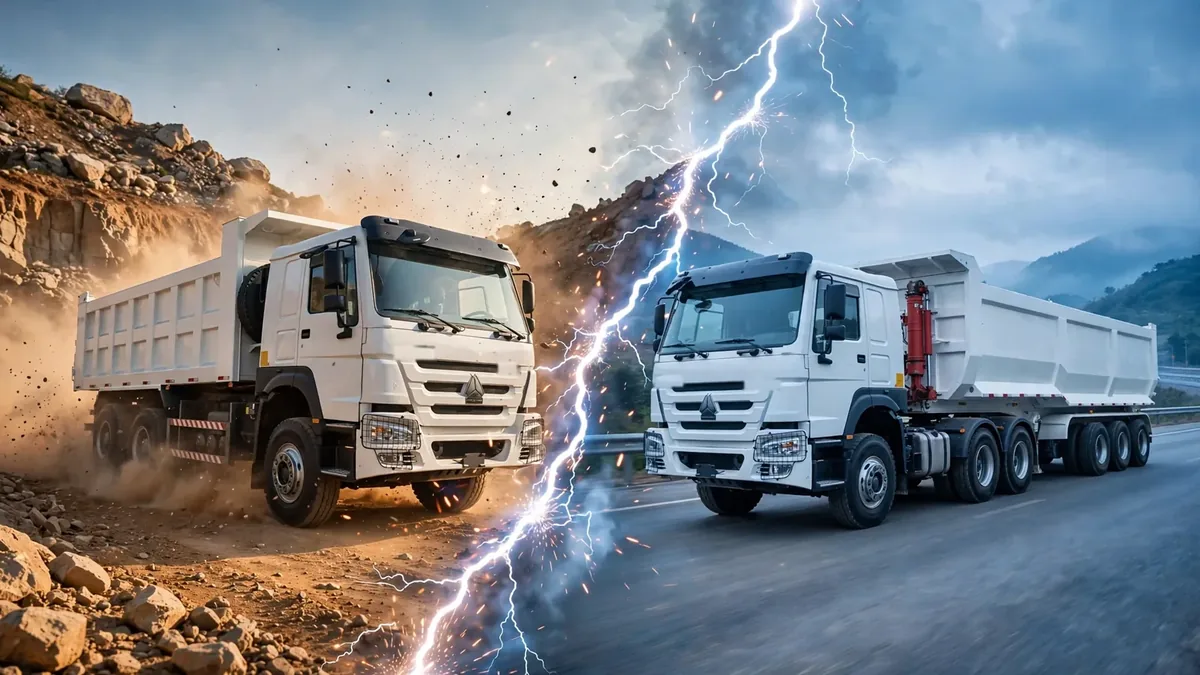
Cover image: illustration, not a photo of a specific vehicle.
Contractors, quarry owners and haulage companies in Africa, Russia, Central Asia, Southeast Asia, the Middle East and Latin America often ask us the same question: should I buy dump trucks or dump semi-trailers? Both carry sand, gravel, earth, ore and construction waste, and both tip their load. But they are built differently, cost differently to run and suit different jobs. This guide compares them side by side.
What is the difference?
Dump truck
A dump truck (also called a tipper truck) combines a driving chassis (engine, gearbox, cab and axles) with a tipping cargo body in one vehicle. It drives itself to the loading point and tips the load with a hydraulic cylinder.
Example from our range: the HOWO 6x4 Dump Truck 371HP has a 20 m³ U-shaped body, a rated load capacity of 30 tons and a kerb weight of 12,500 kg. The HOWO 8x4 Tipper Truck 400HP has a 30 m³ body, a 40-ton load capacity and a kerb weight of 15,000 kg.
Dump semi-trailer
A dump semi-trailer (tipper trailer) consists of a frame with axles and wheels and a tipping cargo body. It has no engine of its own: a tractor truck pulls it, and the tractor's hydraulics usually power the tipping cylinder.
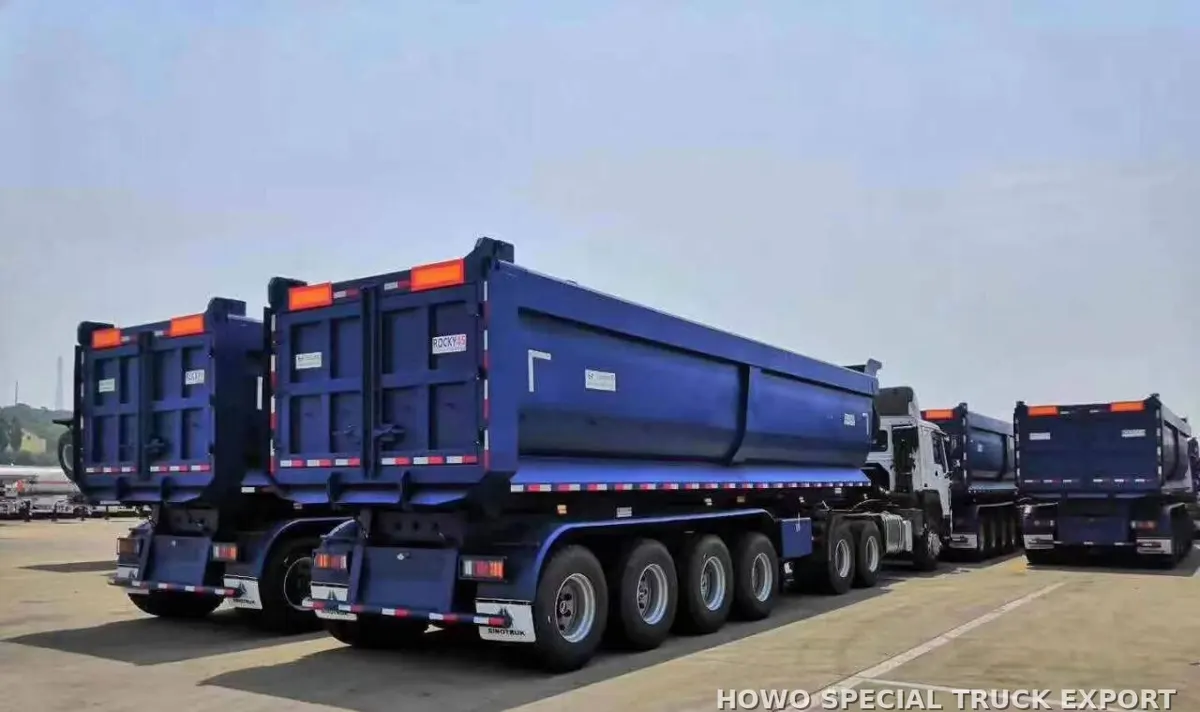
Example from our range: the 4 Axle 40 Cubic Dump Trailer has a 40 m³ U-shape body and a HYVA tipping cylinder, built for mining and quarry work. It is pulled by tractor trucks such as the HOWO 6x4 Tractor Truck 371HP.
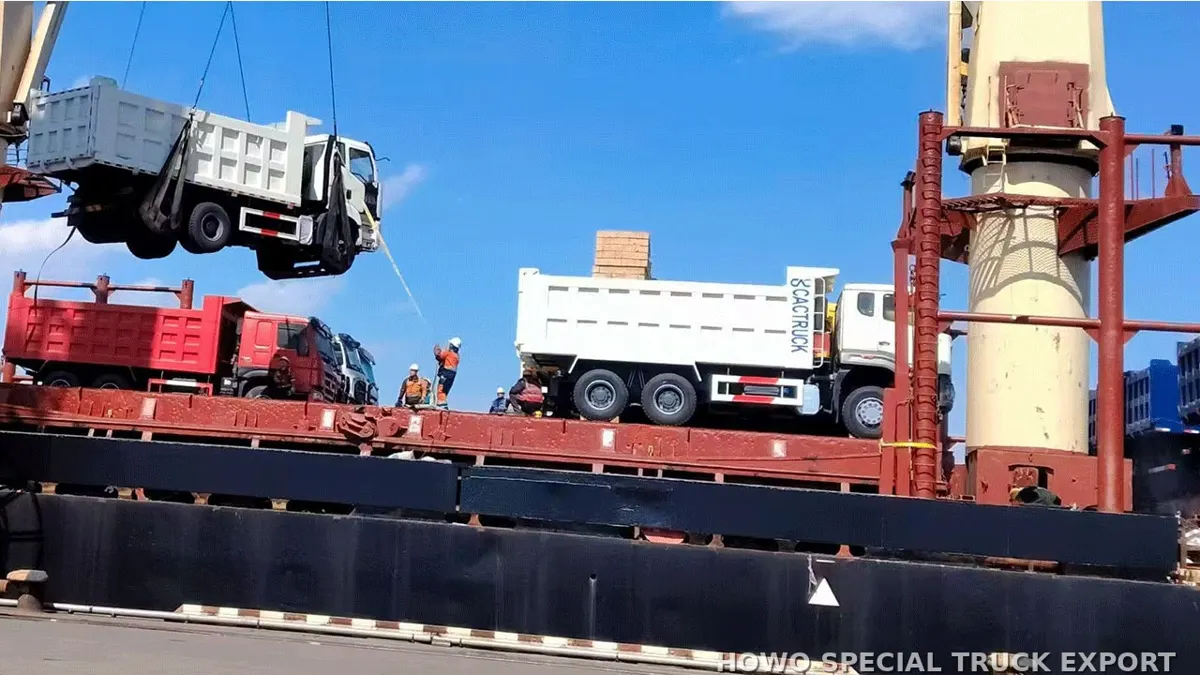
Side-by-side comparison
| Dump truck | Dump semi-trailer | |
|---|---|---|
| Power | Own engine and cab | No engine; needs a tractor truck |
| Units to buy | One | Trailer + tractor (one tractor can work with several trailers) |
| Body volume | Smaller (our 6x4: 20 m³, 8x4: 30 m³) | Larger (our 4-axle: 40 m³) |
| Manoeuvrability | Better on tight sites and sharp turns | Longer combination needs more space |
| Rough roads and steep sites | Generally better traction and control | Best on firm, good roads |
| Tipping stability | Shorter body, more stable on uneven ground | Long body; tip on firm, level ground |
| Best haul distance | Short to medium, many trips | Medium to long, fewer trips |
| Flexibility | Truck is tied to its body | Tractor can be swapped to other trailers |
Dump truck: pros and cons
Pros
- One self-contained unit: simple to operate, register and maintain.
- Short and agile, so it handles small sites, narrow access roads and sharp turns.
- Strong on muddy, sandy or steep site roads. Our 6x4 models have an inter-axle differential lock for traction on loose ground.
- Shorter body is more stable when tipping on uneven ground.
- Quick cycles for short-distance work like site clearance, road building and quarry-to-crusher runs.
Cons
- Smaller body volume per trip than a long tipper trailer.
- The engine and chassis stand idle while the truck is being loaded or waiting.
- On long hauls, carrying less per trip can mean more trips.
Dump semi-trailer: pros and cons
Pros
- Large body volume per trip, which suits long-distance haulage of bulk material.
- The tractor is not tied to one trailer. One tractor can drop a loaded trailer and pick up another, or switch to other trailer types when the dump work slows down.
- If you already run tractor trucks, you only need to add the trailer.
- No engine on the trailer, so fewer engine parts to maintain on the trailer itself.
Cons
- Needs a tractor truck, so the total investment is two units if you don't already have one.
- The long combination is harder to turn and reverse on small or crowded sites.
- Less suited to very rough, soft or steep site roads.
- Tipping a long body needs firm, level ground for safety.
Payload vs volume: match the body to your material
This is the most common buying mistake. Weight = volume × density. A body that is the right size for one material can be too big or too small for another.
Typical bulk densities of common materials (approximate, in t/m³):
| Material | Approx. bulk density (t/m³) | What it means |
|---|---|---|
| Wood chips | 0.6–0.8 | Very light: volume fills long before weight |
| Fly ash | 0.95–1.1 | Light powder |
| Dry loose soil, coal cinder | 1.0–1.2 | Light |
| River sand, crushed concrete | 1.8–2.0 | Medium |
| Sand and gravel mix | about 2.0 | Medium, very common |
| Iron ore (crushed) | 2.6–2.8 | Heavy |
| Steel slag, copper ore | 2.7–2.9 | Heavy |
Example: our 6x4 dump truck has a 20 m³ body. Filled level with sand and gravel at about 2.0 t/m³, that would be about 40 tons, well above its 30-ton rated load capacity. So with dense material you load by weight, not by volume. With light material such as dry soil or cinder, the same body is full at roughly 20–24 tons.
What this means when choosing:
- Light, bulky material (soil, cinder, fly ash, wood chips): a larger body, such as a long tipper trailer or a body with raised sides, carries more per trip.
- Heavy material (ore, slag, rock): the weight limit decides the load, so a very large body brings little benefit. Focus on chassis, axle and body strength instead, and never overload.
- Mixed work: tell us your main materials and we size the body to match.
Always respect your country's axle-load and gross-weight limits. Overloading wears tyres, axles and frames faster and can be illegal.
How to choose: decision guide
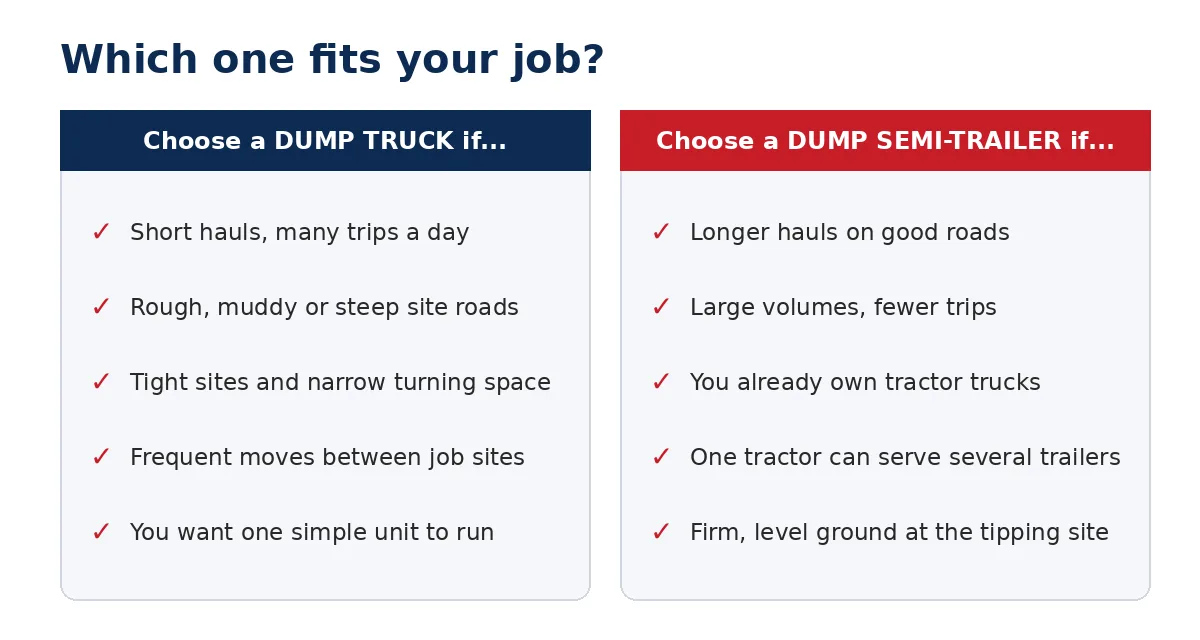
Ask yourself these five questions:
- How far is the haul? Short, repeated trips favour dump trucks. Longer runs on good roads favour semi-trailers.
- What are the roads and sites like? Mud, sand, steep ramps and tight corners favour dump trucks.
- What material, and how dense? Size the body to the material (see the table above).
- Do you already own tractor trucks? If yes, a dump semi-trailer is a lower-cost way to add capacity.
- Is the work steady or seasonal? A tractor can switch to other trailers when dump work is slow; a dump truck stays a dump truck.
Many fleets use both: dump trucks inside the mine or on site, and tractor-and-trailer combinations for long runs to the plant, port or city.
Both are built to order for export
Neither a dump truck nor a dump semi-trailer is a one-size-fits-all product. For export customers we configure each order to the job, for example:
- body size, shape (U-shape or rectangular) and steel grade,
- drive type and engine power for trucks (4x2, 6x4, 8x4),
- number of axles, suspension and tyres for trailers,
- tipping system and cylinder,
- left- or right-hand drive and local compliance needs.
Tell us your material, haul distance, road conditions and local load limits, and we will recommend a configuration.
FAQ
What is the main difference between a dump truck and a dump semi-trailer?
A dump truck has its own engine, cab and chassis in one unit. A dump semi-trailer has no engine and must be pulled by a tractor truck.
Which carries more, a dump truck or a dump trailer?
A dump semi-trailer usually has a larger body. For example, our 4-axle dump trailer has a 40 m³ body, while our 6x4 and 8x4 dump trucks have 20 m³ and 30 m³ bodies. With heavy material, the legal weight limit, not the body volume, decides how much you can carry.
Which is better for mining and rough roads?
Dump trucks are generally better on rough, steep or muddy site roads and in tight spaces. Dump semi-trailers work best on firm, good roads over longer distances.
Can one tractor truck pull several dump trailers?
Yes, one at a time. One tractor can drop a trailer for loading and pick up another, and it can also pull other trailer types when dump work is slow.
Can you customise the dump truck or trailer for my country?
Yes. For export, both are built to order: body size and steel, drive type, axles, tyres, tipping system and steering side are configured to your material, roads and local rules.
Get a quote
Browse our dump trucks, dump trailers, tractor trucks and semi-trailers. Not sure which fits? Send us an inquiry or message us on WhatsApp with your material, haul distance and road conditions, and we will suggest the right setup and price.