EU Digital Battery Passport 2027: What Buyers of Chinese EVs and Batteries Need to Know
From 18 February 2027, EV batteries, light-means-of-transport (LMT) batteries and industrial batteries above 2 kWh placed on the EU market will need a digital battery passport. Here is what it records, who is affected, and what it means for buyers of electric vehicles and batteries from China.
Last updated: October 2026
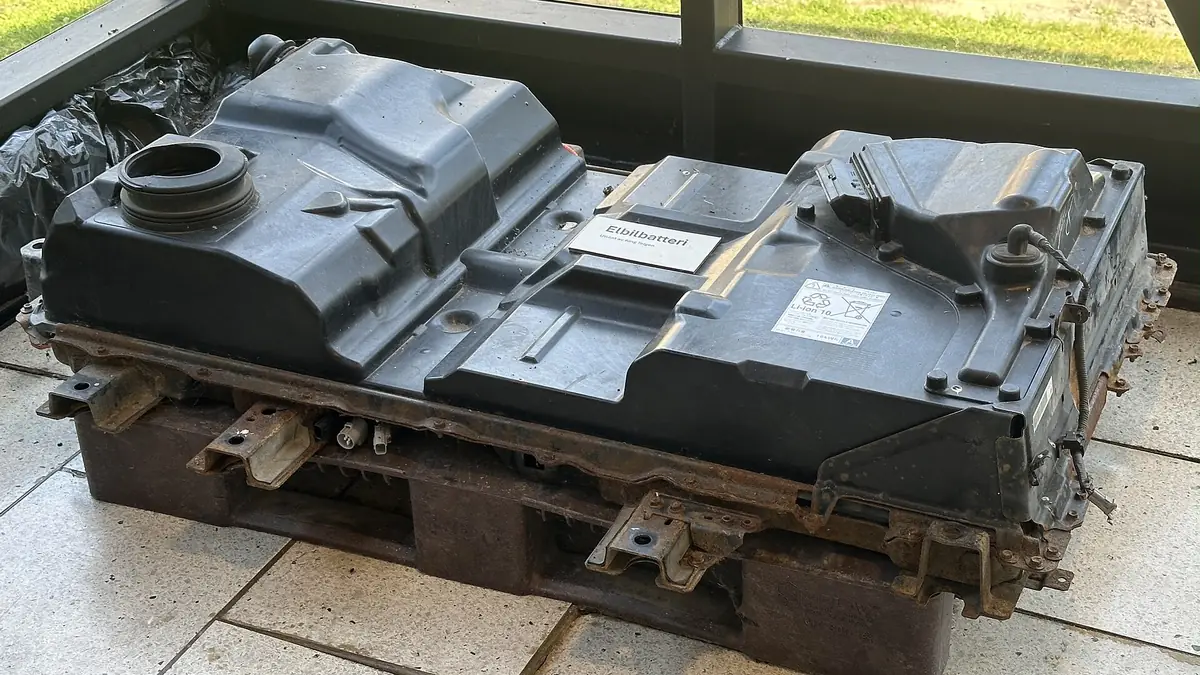
Cover photo: electric car Li-ion battery pack, by Wolfmann, CC BY 4.0, via Wikimedia Commons. Cropped.
Until now, exporting a lithium battery from China mostly meant one question: can this cargo be shipped safely? From 2027, buyers selling into Europe also have to ask a second one: does this battery meet the market access rules of the destination? The EU's digital battery passport is the main reason. This guide explains it in plain language for dealers, fleet owners and importers who buy electric vehicles, vans or batteries from China.
What is the EU digital battery passport?
Think of it as a digital ID card for a battery. It is an electronic file that keeps information about the battery from the factory onward, through use and repair, to final recycling. Under the EU rules, people such as consumers, repair shops, recyclers and regulators can view the information, each with their own access rights.
What information does it record?
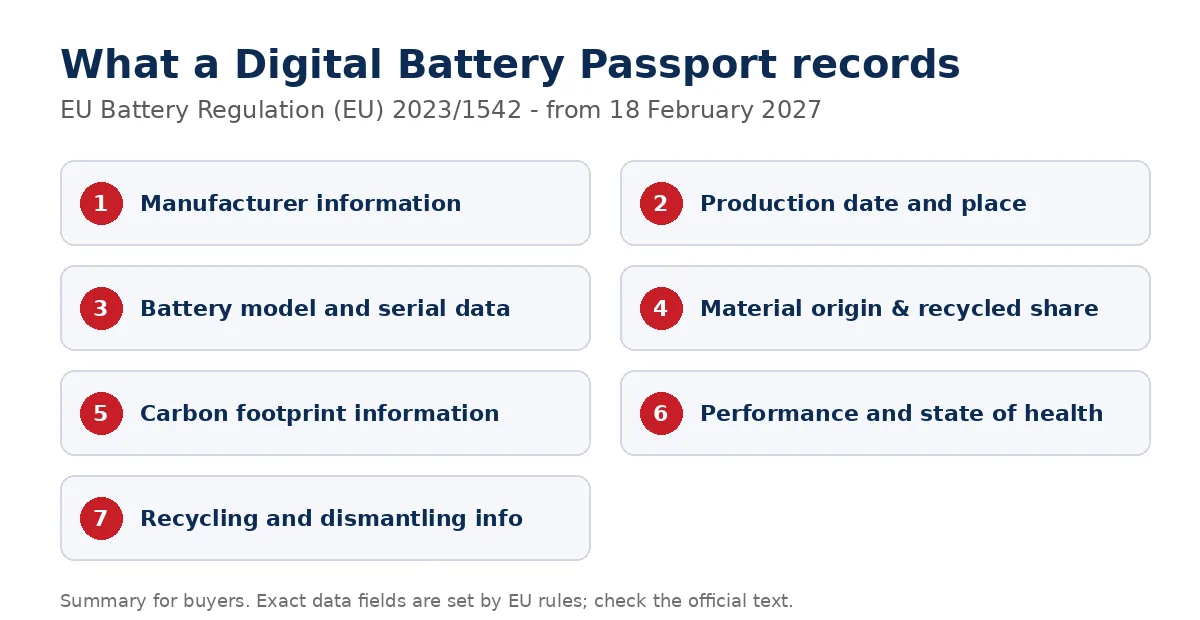
Based on the EU requirements, a battery passport may include:
- Information about the battery manufacturer
- Production date and place
- Battery model and serial information
- Origin of materials and the share of recycled material
- Carbon footprint information
- Battery performance and state of health
- Recycling and dismantling information
The exact data fields, and who may see which fields, are set out in Annex XIII of the regulation. Check the official text for your product.
Why is the EU introducing it?
Battery supply chains are long and cross many countries: mining, raw material processing, cell manufacturing, pack assembly, use and recycling. The EU wants digital records to make that chain more transparent, and to:
- reduce carbon emissions,
- raise battery recycling rates, and
- better control where raw materials come from.
The result is that battery products entering the EU market will face stricter compliance requirements than before. Product performance and price still matter, but supply chain transparency and data management become part of the competition too.
Who needs to prepare before 2027?
Not every product with a battery is affected right away. These groups should start preparing now:
1. Electric vehicle and traction battery companies
EV battery packs and traction battery systems are a main focus of the rules.
2. Energy storage battery suppliers
Energy storage has grown fast in recent years. Large storage cabinets and industrial batteries exported to Europe also need to follow the requirements.
3. Battery trading and export companies
Many trading companies source batteries from Chinese factories and export them. If the factory cannot provide complete documentation, this can later affect customer factory audits, market access and customs clearance.
What about diesel trucks?
Our core products, such as HOWO dump trucks and tractor trucks, are diesel trucks with a 24V starter battery system. Article 77 applies the passport to EV, LMT and industrial batteries above 2 kWh. The regulation defines starting, lighting and ignition (SLI) batteries as a separate category, and they are not on that list, so a diesel truck's starter batteries do not need a battery passport. (SLI batteries still have other obligations under the regulation, such as labelling and collection.) Note that the EV battery definition includes traction batteries for electric trucks and buses (vehicle categories M, N and O), so an electric truck's battery would be covered. The passport rule mainly concerns the electric cars and electric vans we also export, and any loose batteries shipped with an order.
What changes for buyers of Chinese EVs and batteries?
In the past, the checklist for exporting lithium batteries focused on:
- MSDS (material safety data sheet)
- UN38.3 test report
- dangerous goods transport rules
In the future, the battery's own data also matters. Before you order for the EU market, ask your supplier:
- Is the battery information complete?
- Can the supply chain documents be traced?
- Can production data be stored for the long term?
- Is carbon footprint data available?
If you sell outside the EU, these questions are still a good sign of a reliable supplier.
Lithium battery shipping: the documents you still need
The battery passport is about product compliance, but it adds to an existing trend: stricter rules for shipping batteries internationally. For any lithium battery export today, check:
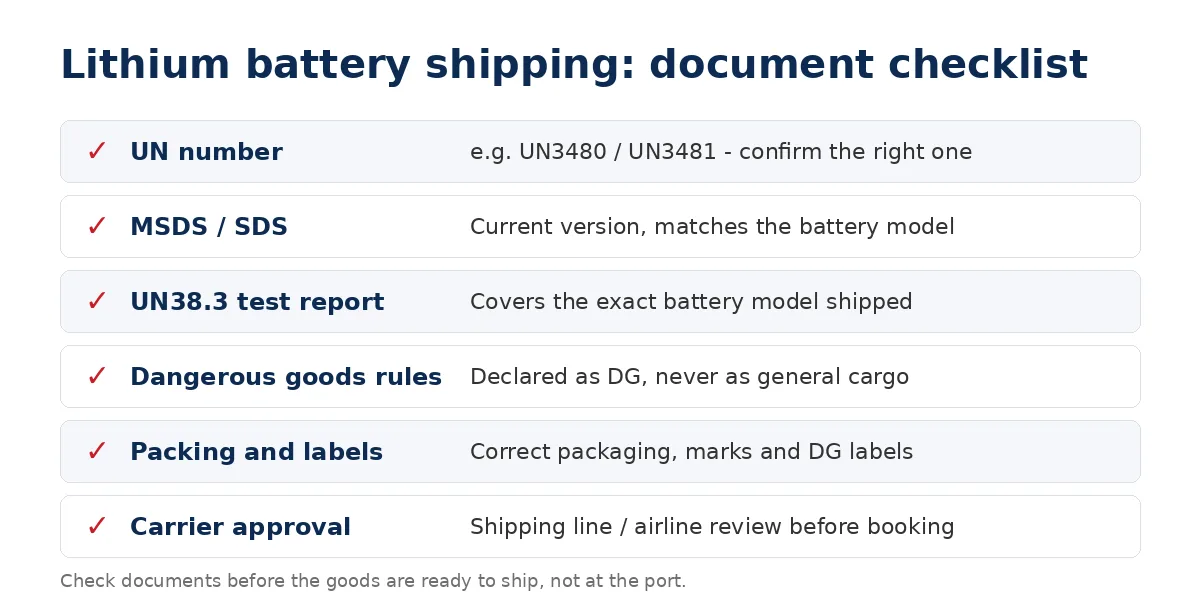
| Item | What to check |
|---|---|
| UN number | The correct UN number for the cargo, for example UN3480 or UN3481 |
| MSDS / SDS | A current version that matches the battery model |
| UN38.3 test report | Available for the exact battery model shipped |
| Dangerous goods rules | Declared and handled as dangerous goods |
| Packing and labels | Packaging, marks and labels meet the requirements |
| Carrier approval | The shipping line or airline has reviewed and accepted the cargo |
Common problems that delay shipments
- The battery model does not match the documents
- The MSDS is an old version
- The UN38.3 report is missing
- Batteries declared as general cargo, so the carrier refuses the booking
All of these can hold up a shipment. The fix is simple: confirm the documents before the goods are ready to ship, not at the port, and plan the transport method early.
Does this matter outside Europe?
Many of our buyers are in Russia, Central Asia, Africa, Southeast Asia, the Middle East and Latin America. The EU battery passport does not apply directly in these markets. For example, the Philippines and Malaysia are not covered by the EU rule.
But battery rules around the world are getting stricter. Whether you import energy storage equipment, electric vehicles, battery packs or electronics containing lithium batteries, complete and consistent documents will make shipping and clearance smoother, wherever the destination is.
FAQ
When does the EU digital battery passport start?
From 18 February 2027, under the EU Battery Regulation (EU) 2023/1542.
Which batteries need a battery passport?
Under Article 77, every electric vehicle battery, every light means of transport (LMT) battery and every industrial battery with a capacity above 2 kWh placed on the EU market or put into service. Starter (SLI) batteries, such as those in diesel trucks, are not covered.
Does the battery passport replace MSDS and UN38.3?
No. The passport is about product compliance in the EU market. Shipping lithium batteries still needs the correct UN number, a current MSDS/SDS, a UN38.3 test report and dangerous goods handling.
Does it apply if I import into Africa or Southeast Asia?
Not directly. The rule covers the EU market; for example, the Philippines and Malaysia are not covered. But battery shipping rules are tightening worldwide, so complete documents still help.
What should I ask my Chinese supplier now?
Whether battery information is complete, whether supply chain documents can be traced, whether production data is stored long term, and whether carbon footprint data is available.
How we help
We have been exporting trucks, semi-trailers, machinery and vehicles from Jinan, China since 2010, to customers in more than 80 countries. For our customers, we check the MSDS, UN38.3 test report and dangerous goods documents for electric vehicles and battery-related cargo, so they match the exact model before booking.
Browse our cars, pickups and vans, including the Foton EVM2 12-seat electric van and BYD Yuan Plus, or our HOWO trucks. Ready to plan an order? Send us an inquiry or message us on WhatsApp for a quote and shipping advice.
Sources
- Regulation (EU) 2023/1542 of the European Parliament and of the Council concerning batteries and waste batteries (EUR-Lex): https://eur-lex.europa.eu/eli/reg/2023/1542/oj (Article 3 definitions (11) LMT, (12) SLI, (13) industrial and (14) EV battery; Article 77 battery passport; Annex XIII)