Africa COC Certificate Guide: SONCAP, PVoC & CBCA for Truck Importers (2026)
Which African countries require a COC, SONCAP, PVoC or CBCA certificate, which documents to prepare, step-by-step procedures for Nigeria, Ethiopia and Ghana, and how to avoid port delays when importing trucks from China.
Last updated: October 2026
If you are a dealer, fleet owner or contractor in Africa buying HOWO trucks, semi-trailers, machinery or spare parts from China, the COC is often the document that decides whether your cargo clears smoothly or sits at the port. This guide covers which countries require one, what each asks for and how to plan your order around it.
What is an African COC certificate?
A COC is issued by an inspection body appointed by the importing country's standards authority (for example KEBS in Kenya or SON in Nigeria). It confirms that a specific shipment, or a registered product, complies with that country's technical standards.
Governments use it for three reasons:
- Quality and safety: keeping substandard or unsafe products off the market.
- Revenue protection: inspectors check declared values, which helps prevent under-invoicing.
- Health and environment: blocking non-compliant goods before they arrive.
Programmes typically cover food, chemicals, electrical goods, textiles and machinery. Vehicles and spare parts usually fall under the same programme or a dedicated vehicle inspection scheme, depending on the country.
Which African countries require a COC? (11-country overview)
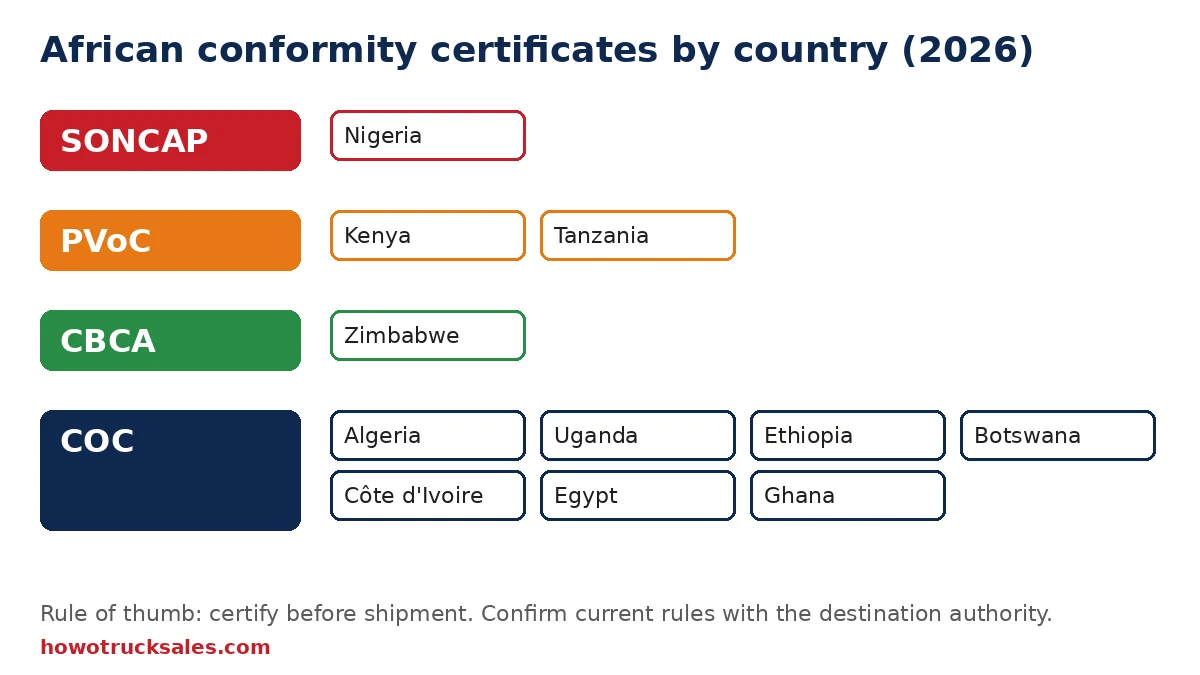
| Country | Certificate name | Key point for importers |
|---|---|---|
| Algeria | COC | Covers almost all regulated imports. Test reports must come from an ILAC/CNAS-accredited laboratory, and an ISO 9001 certificate is requested. |
| Nigeria | SONCAP | Three stages: Product Certificate (PC), then the importer's Form M, then the Shipment Certificate (SC). |
| Kenya | PVoC | New 3-year PVoC contracts started on 19 February 2026. Used vehicles, mobile equipment and spare parts have a separate inspection arrangement. |
| Tanzania | PVoC | 11 product groups, with electrical goods and machinery as priorities. Inspection must be done before shipment. |
| Uganda | COC | Covers toys, electrical goods, auto parts, chemicals and gas equipment. Packaging photos must show the country of origin. |
| Zimbabwe | CBCA | 12 product groups. The conformity check must be completed before dispatch. |
| Ethiopia | COC | Most industrial goods, appliances and building materials. The certificate is linked to the customs system. |
| Botswana | COC | Food, toys, electrical goods and other regulated items. |
| Côte d'Ivoire | COC | Valid for one shipment only: every shipment needs a new certificate. |
| Egypt | COC | Managed by GOEIC. The source reports certificates issued in 3–5 working days. |
| Ghana | COC | Avoid changing cargo details after submission, because changes cause delays. |
Requirements change often. Always confirm the latest rules with the destination authority or your clearing agent before shipping.
Documents you usually need
Most programmes ask for the same core set. Make sure the HS code, quantity, weight and value are identical on every document.
| Document | Prepared by | Notes |
|---|---|---|
| Request for Certification (RFC) / application form | Exporter or importer | One per shipment for most countries |
| Commercial invoice with FOB value and HS codes | Exporter | Algeria specifically asks for FOB value and HS code |
| Packing list | Exporter | Must match the invoice |
| Test report | Accredited laboratory | ILAC/CNAS (Algeria), ISO/IEC 17025 (Uganda, Kenya recommendation) |
| Technical data / product specifications | Exporter | For trucks: model, engine, chassis/VIN numbers |
| ISO 9001 certificate | Manufacturer | Requested by Algeria |
| Product photos and labels | Exporter | Uganda: country-of-origin marking; Zimbabwe: English manual and compliant labels |
| Import ID: IDF (Kenya, Uganda), TIN (Uganda), Form M (Nigeria) | Importer | The importer arranges this locally |
Step-by-step: Nigeria, Ethiopia and Ghana
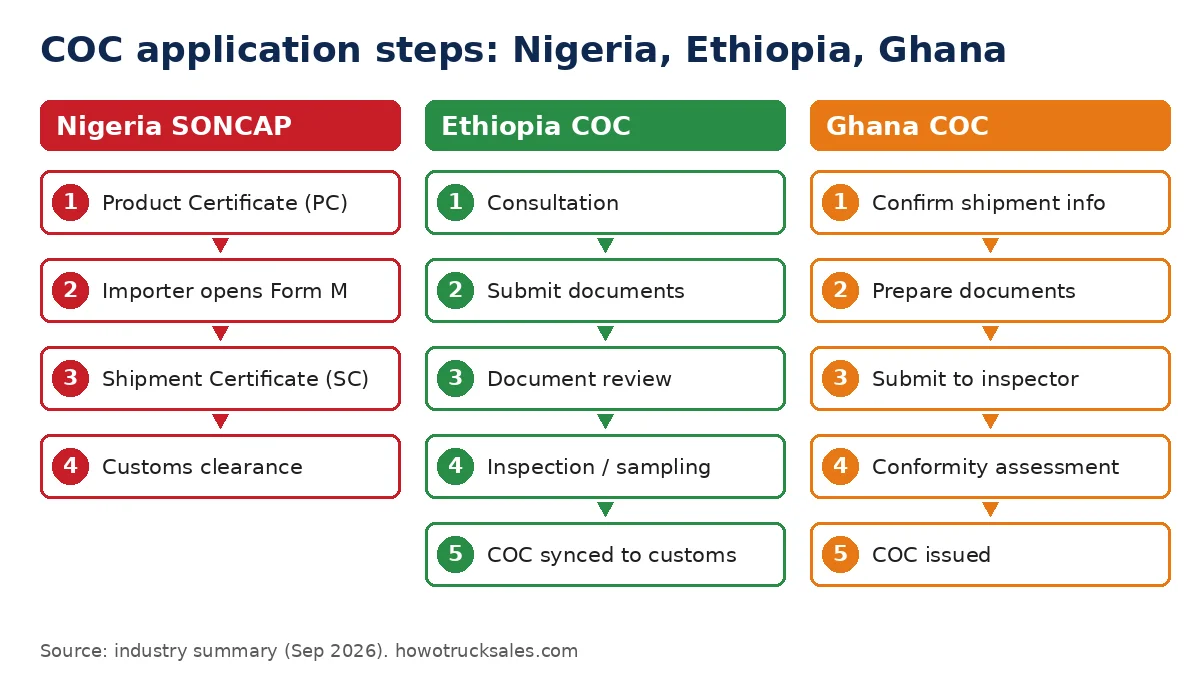
Nigeria (SONCAP)
- Apply for the Product Certificate (PC) for the product category.
- The importer in Nigeria opens Form M.
- Apply for the Shipment Certificate (SC) with Form M, invoice, packing list, the PC and the original Bill of Lading. The SC is used for customs clearance.
Ethiopia (COC)
- Consultation and assessment.
- Document submission.
- Document review.
- Pre-shipment inspection or sampling.
- Certificate issued and synced to Ethiopian customs.
Ghana (COC)
- Confirm shipment information.
- Prepare documents.
- Submit to the inspection body.
- Conformity assessment.
- Certificate issued.
Worked example: a truck order to Kenya
Say a contractor in Nairobi orders a HOWO 6x4 dump truck 371HP and a 3-axle 40ft flatbed trailer.
| Step | Who | When |
|---|---|---|
| 1. Importer files the IDF in Kenya | Buyer | After signing the proforma invoice |
| 2. Exporter sends invoice, packing list, specifications and chassis/VIN numbers to the inspection body | Us | During production |
| 3. Pre-shipment inspection at the factory or port | Inspection body | Before loading |
| 4. COC issued, number shown on shipping documents | Inspection body / us | Before the vessel sails |
| 5. Clearance at Mombasa with the COC | Buyer's clearing agent | On arrival |
What if the COC is missing? According to KEBS, goods shipped after 1 March 2026 from regions covered by the new PVoC contracts without a valid COC face a destination inspection fee of 5% of the approved customs value (Legal Notice No. 78). On a shipment with a customs value of USD 100,000, that is USD 5,000, plus storage and delay costs. Pre-shipment certification is almost always the cheaper option.
For containerised cargo to Kenya you will also need an Advance Cargo Declaration. See our Kenya ACD guide.
2026 changes to watch
- Stricter enforcement: several African countries have raised fines for uncertified cargo and shortened the window for late certificates.
- Kenya goes digital: the new PVoC cycle from 19 February 2026 relies on electronic submission, so scanned documents must be complete and consistent.
- Per-shipment rules: Côte d'Ivoire issues a COC for one shipment only. Plan certificates for each batch when you split an order.
Common mistakes that delay your COC
- HS codes or values that differ between the invoice, packing list and application.
- Changing quantities or models after submission (a known issue in Ghana).
- Test reports from a laboratory that is not accredited.
- Booking the vessel before the inspection date is confirmed.
- The importer forgetting local registration (Form M, IDF, TIN).
How we help with COC shipments
We have exported HOWO trucks, trailers and machinery to 60+ countries, shipping more than 3,000 units per year from our 200,000 m² plant in Jinan. Our factory holds ISO 9001 certification. Every truck goes through a 128-point inspection and a 50 km road test before delivery and is backed by a 100,000 km warranty.
For every African order we prepare invoices, packing lists, specifications and chassis/VIN data in a consistent format and coordinate pre-shipment inspection with the appointed inspection body. See our deliveries to Ghana, Tanzania and Kenya.
Popular models for African buyers:
- HOWO dump trucks, including the HOWO 8x4 tipper truck 400HP
- HOWO tractor trucks, such as the HOWO 6x4 tractor truck 371HP
- Fuel tanker trailers and lowbed trailers
- Genuine HOWO spare parts
FAQ
Is a COC the same as SONCAP, PVoC or CBCA?
They serve the same purpose. SONCAP is Nigeria's programme, PVoC is used by Kenya and Tanzania, and CBCA is Zimbabwe's. Other countries simply call it a COC.
Who applies for the COC, the exporter or the importer?
Usually both are involved. The exporter submits product documents and makes the goods available for inspection. The importer handles local registrations such as Form M (Nigeria) or IDF (Kenya). We coordinate the exporter side for you.
Do trucks and spare parts need a COC?
In most COC countries, yes. Machinery and auto parts are named in several programmes. Some countries, including Kenya, handle used vehicles and spare parts under a separate inspection arrangement, so confirm with your clearing agent.
How long does it take to get a COC?
It depends on the country and the inspection date. The source reports 3–5 working days in Egypt. Allow extra time for inspection booking and plan it during production.
What happens if I ship without a COC?
You risk fines, destination inspection fees (5% of customs value in Kenya for covered regions since 1 March 2026), delays, seizure or re-export.
Is one COC valid for several shipments?
Not always. In Côte d'Ivoire it covers a single shipment. In Nigeria, the Product Certificate covers a product, but every shipment still needs its own Shipment Certificate.
Get a quote with COC support
Tell us your destination country, the model and the quantity. We will confirm the certification route and include it in your shipping plan.
Send an inquiry or chat with us on WhatsApp.
---
Sources: summary of "Practical guide: Africa COC certification" published by a Chinese trade facilitation account (18 Sep 2026), republished by Tianjin Port International Forwarding on WeChat; KEBS public notice on expiry of PVoC contracts (Feb 2026); KEBS announcement of new PVoC service providers (18 Feb 2026), as reported by People Daily and Business Today Kenya. Requirements are subject to change by each national authority.