Buying a Fuel Tanker Trailer from China? Configuration Details You Might Overlook
Liters and price are easy to compare. Sealed compartments, perforated surge baffles, shell material and discharge fittings are the configuration details buyers often skip on a fuel tanker semi-trailer from China.
Published: 9 November 2026.
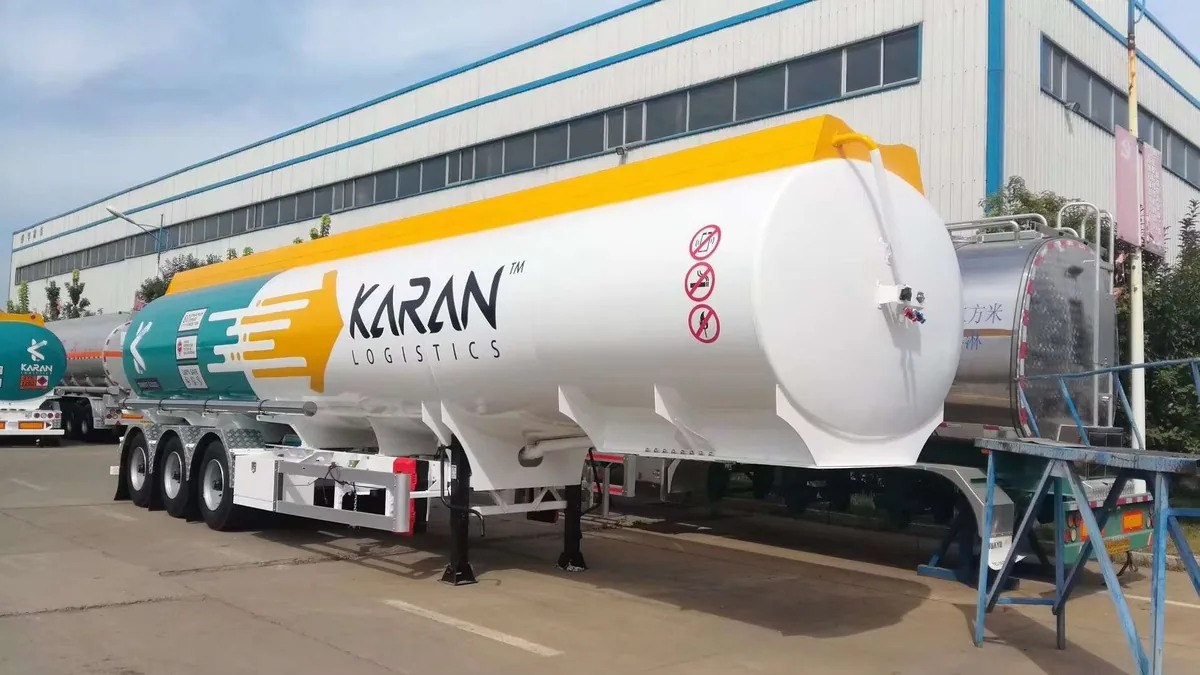
The photo at the top shows a fuel tanker semi-trailer parked in a factory yard, landing gear down, with factory buildings behind it. The lettering on that tank is the livery in the photograph. It is not a statement that the operator is a customer or partner of HOWO Special Truck Export Co., Ltd, and the picture is not a capacity, material or destination specification.
What buyers compare first, and what they skip
A fuel tanker trailer — also called a fuel tanker semi-trailer — carries diesel, gasoline or kerosene between depots and filling points. HOWO Special Truck Export Co., Ltd lists two current semi-trailer models for that work. Most inquiries start with capacity and price. A shortlist that stops there misses the configuration that decides whether the tanker matches the drops you make.
This note is buyer guidance. It turns public engineering ideas about atmospheric liquid tanks into checks you can put on a drawing. It is not a record of a delivery by our company, and it is not a finite-element study we performed.
Road and tank rules differ by country. Match the specification to the destination before you order, and ask which documents that destination needs. This page does not promise that a listed option satisfies those rules.
Sealed compartments and perforated surge baffles are different parts
An atmospheric fuel tank is a shell with heads, fittings and internal plates. Two of those plates get mixed up in inquiries:
| Plate | What it does | What it does not do |
|---|---|---|
| Sealed compartment partition | Closes one bay off from the next so grades do not mix | It does not stop liquid moving inside a single bay, and it does not contain every breach of the shell |
| Perforated surge baffle | Breaks a longitudinal wave when the tank is only partly full | Liquid passes through the openings, so it does not separate grades and it does not seal a bay |
Ask for both on the drawing, by name. A baffle count is not a compartment count. A compartment plan is not proof that surge plates are fitted, or that those plates are perforated rather than solid.
Compartments
A sealed partition lets one trailer carry more than one grade — diesel in one bay, gasoline in another — and it sets the drop size at each stop. If the shell of one bay is damaged and the partition holds, product in the other bays is not automatically lost with it. Fleets use compartments for that reason. It is not a promise that any breach stays inside the tank, and it is not a promise that every partition survives every impact.
On the current product pages:
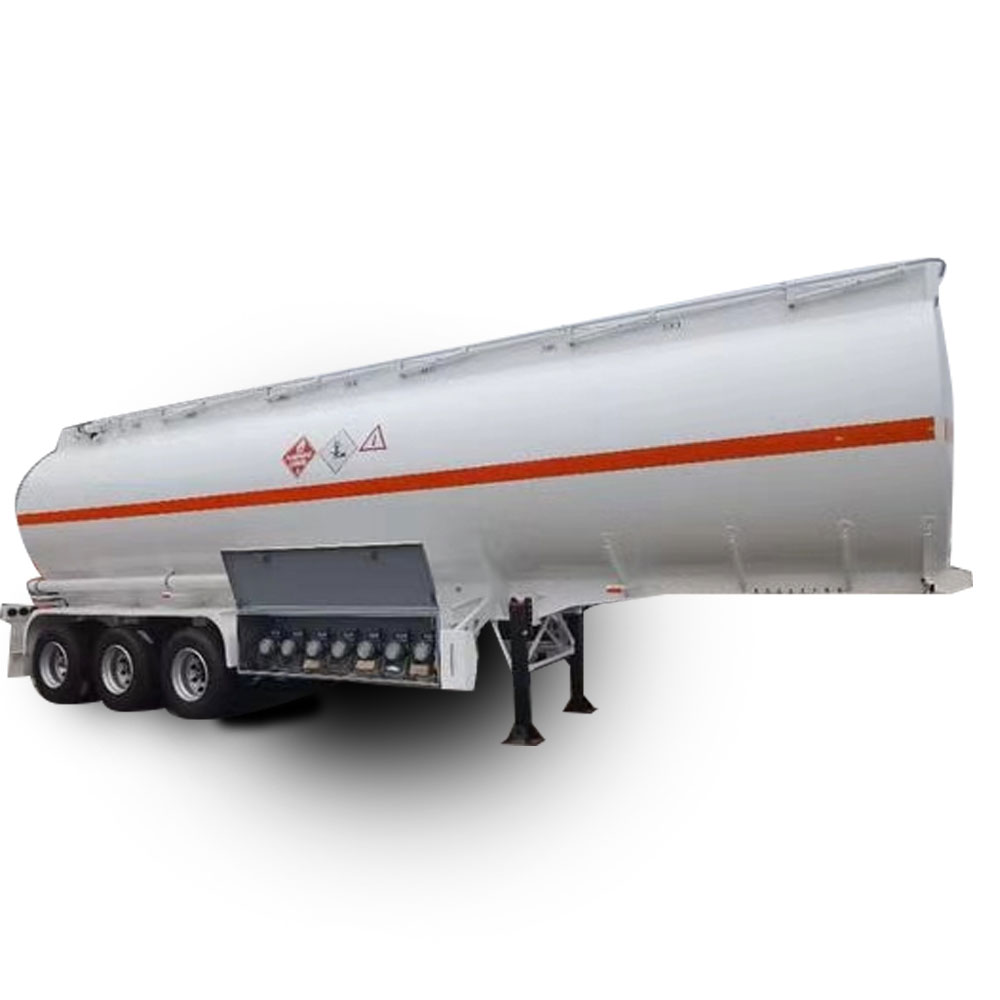
- The 3-axle carbon steel tanker trailer, 45,000 liters is listed with 5 compartments, for diesel, gasoline and kerosene. The same page says compartment count can be discussed from 3 to 7. Confirm the bay volumes on the drawing you approve.
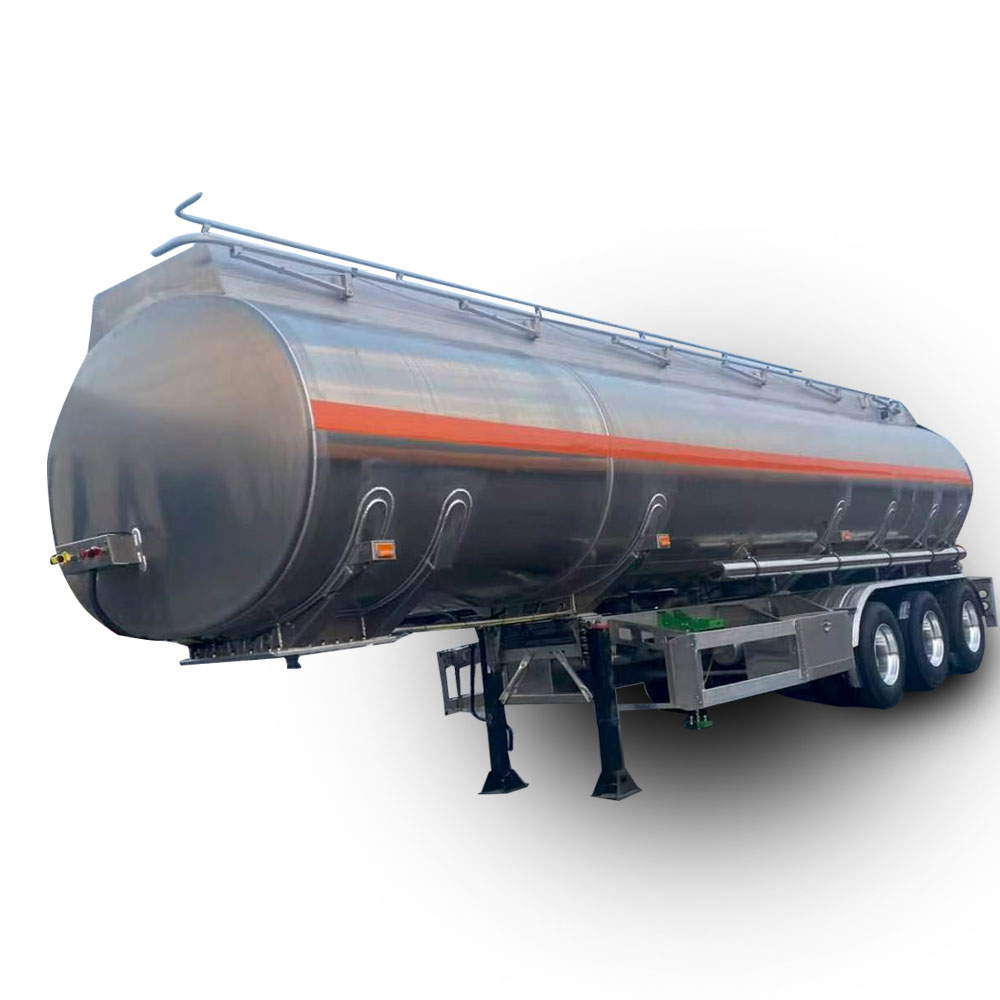
- The 3-axle aluminum tanker trailer, 50,000 liters is listed with 7 compartments in 5454 aluminum alloy (the specification table names 5454-H32). That page says compartment sizes can be customized. Confirm those sizes on the drawing.
Surge baffles
Light fuels move when the driver brakes or corners and the tank is not full. A perforated baffle is there to break that wave. Chinese writing on atmospheric tank vehicles often discusses baffles for low-viscosity liquids when the shell is only partly filled. Treat that as a question for your drawing: how many baffles, whether they are fixed or removable, whether the plate is perforated, and whether a person can pass them for inspection.
A baffle does not make a partly filled tanker stable on every road. It does not replace axle rating, brake spec, fill level or the destination road rules.
50,000 liters is not a 50-ton legal payload
Tank volume and legal payload are different numbers.
- 45,000 L and 50,000 L on these pages are volumes.
- The tonnes you may carry depend on the density of the fuel and on axle and gross limits in the destination. Diesel and gasoline are lighter than water, so a full 50,000-liter tank is not 50 tonnes of fuel, and it is not permission to run at 50 tonnes where the road limit is lower.
- A listed axle rating is hardware on the page, not the legal axle load in your country. The carbon-steel page lists 3 × 13-ton axles as BPW or FUWA. The aluminum page lists 3 × 13-ton BPW axles.
Do not convert liters to tonnes by assuming the density of water, and do not read a volume as a payload guarantee. Put the fuel grade and the destination weight limits in the inquiry.
Shell material: carbon steel or aluminum
- Carbon steel is the listing when the repair network already works in steel. The 45,000 L page names carbon steel, and the specification table names Q345B.
- Aluminum is the listing when tare weight is the constraint you are trying to ease. The 50,000 L page names 5454 aluminum alloy. A lighter shell can leave more of the legal gross weight for fuel. It does not raise that legal limit, and it does not turn 50,000 liters into a 50-tonne payload.
Chinese tank-vehicle practice publishes thickness notes by diameter and alloy. Treat those notes as manufacturing context for equipment built in China. The code named in your tender is the one that governs acceptance. This article does not reprint those tables as if they were your national standard.
Head shape, and a round shell versus a non-round shell, are stiffness and cost choices. They belong on the drawing for your order.
Insulated or heated tanks are a different duty, such as bitumen or some food liquids. The two fuel listings above are ambient fuel semi-trailers.
Fittings that belong in the inquiry
- Manholes, and whether the vent is a pressure/vacuum breather or a simpler opening. The specification tables list a manhole on each compartment. Confirm diameter and top protection on the drawing.
- Top loading or bottom loading, and the coupler your depots already use.
- Discharge piping, a low-point drain, and whether hoses and pipework are bonded. Each product page lists a discharge pump and a retractable grounding reel. The carbon-steel page lists the pump at 500 L/min or more. The aluminum page lists it at 600 L/min or more. Confirm the line that will be built, including whether a meter is included.
- Axle brand, ABS or EBS, landing gear and toolbox. On the carbon-steel page, WABCO ABS is listed and EBS is marked optional. On the aluminum page, WABCO ABS and EBS are both listed.
- The destination documents you need for import or registration. Ask for them by name. This article does not promise a certificate.
A rigid fuel tank is a different product. The HOWO 6x4 fuel truck, 20,000 liters carries the tank on its own chassis. This article is about the semi-trailer.
How to choose between the two listings
- Mixed drops and a steel repair network: start with the 45,000 L carbon steel tanker trailer.
- More liters and a lighter shell: compare the 50,000 L aluminum tanker trailer.
- Both sit on fuel tanker trailers.
FAQ
What configuration details are easy to miss on a fuel tanker trailer from China?
Compartment count versus surge-baffle count, whether those baffles are perforated, shell material, discharge and bonding fittings, and the difference between tank volume and the legal payload in your country. Liters and price do not settle those points.
What is the difference between a sealed compartment and a surge baffle?
A sealed compartment partition separates fuel grades. A perforated surge baffle lets liquid through so a wave in a partly filled tank is broken up. One does not replace the other. Ask for both on the drawing.
Is a 50,000-liter fuel tanker a 50-ton payload?
No. 50,000 liters is a volume. It is not a 50-tonne legal payload. Diesel and gasoline weigh less than the same volume of water, and the tonnes you may carry are set by fuel density and by axle and gross limits in the destination.
Why specify more than one compartment?
To carry more than one grade on the same trip and to match bay size to the drops you make. If one bay is damaged and the partition stays intact, product in the other bays is not automatically lost with it. That is not a promise that every breach of the shell stays contained.
Do surge baffles make a partly filled tanker stable?
They are fitted to break a longitudinal wave. They do not make the vehicle stable in every road condition, and they are not a handling certificate. Confirm baffle count, perforation and inspection access on the drawing, and confirm axle and brake spec against your routes.
Should I choose the carbon-steel or the aluminum listing?
The 45,000-liter listing is carbon steel with 5 compartments. The 50,000-liter listing is 5454 aluminum with 7 compartments. Steel is the usual repair path. Aluminum is the lighter shell. Neither figure is a legal payload, and neither choice is a destination certificate.
How do I request a quotation?
Send the tractor, target volume, fuel grades, compartment plan, whether surge baffles must be listed separately from compartments, and the destination port through the contact page.
How to ask for a quotation
Send the tractor you will use, the target volume, the fuel grades, the compartment plan, whether surge baffles must be called out separately, and the destination port. Use the contact page. WhatsApp on that page reaches the same desk.
Sources
- Third-party technical article (Chinese), not our shipment record: 《常压液体罐车构造与设计》, https://mp.weixin.qq.com/s/icw-Yqrq-deB0ToJ-9LE8Q (account 匠芯质造, published 22 October 2026, Asia/Shanghai). Regulatory tables and calculation formulas are omitted. Rewritten here for overseas buyers of fuel tanker semi-trailers.
- Product pages used for the model figures above: fuel tanker trailers, 45,000 L carbon steel, 50,000 L aluminum.